A Love Letter to America

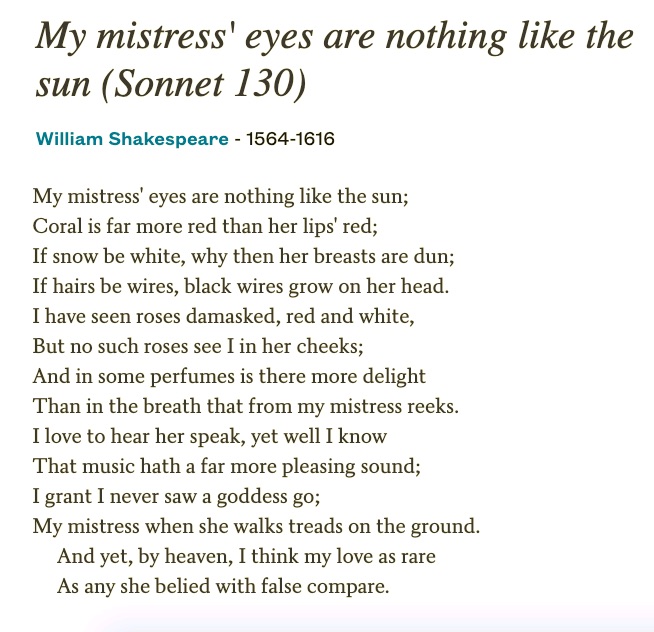
https://poets.org/poem/my-mistress-eyes-are-nothing-sun-sonnet-130

American Democracy, I know you and I have had our differences in the past. I may not agree with those who sing all of your praises, who call you “leader of the free world”. With the increase of democracy and globalization, now more than ever, that sentiment rings false. American Democracy, you’re getting old. But just because you are not exceptional in every way, as some may insist you are, doesn’t mean that there aren’t things to admire about you.

The first thing you’ve done that I admire can literally be called your first (amendment.) Since 1791, your people have had the freedom to say what they feel without fear of your retribution. This was especially radical when you first came into being. Compared to other nations’ citizens, like Great Britain, the protected speech early Americans enjoyed was much more expansive. Today, as a result of hundreds of years of court determination, you continue to be the most speech-protective country in the world.

This leads into the second thing I love about you. The words of your laws, while incredibly important, are not the sole arbiter of your intentions. The Supreme Court and other court systems give your laws, rules, and regulations flexibility. You, from your very first day, have acknowledged that everything has room for interpretation. You allow yourself to change, to be argued, discussed, and revised by the people who know the most about you. For a human, this would take humility. For a country, it takes incredible foresight from its leaders.

The third thing I love about you, American Democracy, is perhaps a bit more personal. Through a series of your decisions, mistakes, and quirks, you have created one of the most vibrant arts scenes on the face of the planet. American music is a marvel. So many styles of contemporary music, like jazz, country, and hip-hop, have their roots, for better or for worse, in your decisions. Your diversity of race, religion, and location brings all sorts of people and cultures together, bringing us some of the world’s best music (and also Insane Clown Posse, but I won’t hold that against you).

America, you remind me of Shakespeare’s love from his 130th sonnet. You, too, are often “belied with false compare” by the myth of American exceptionalism. You aren’t perfect. But perfection is unrealistic, and just as Shakespeare still finds things to admire in his love, we can find things to admire in you, things much more true and admirable than any sweeping generalization could be.

The Iowa Caucuses: a Tragedy in Two Acts

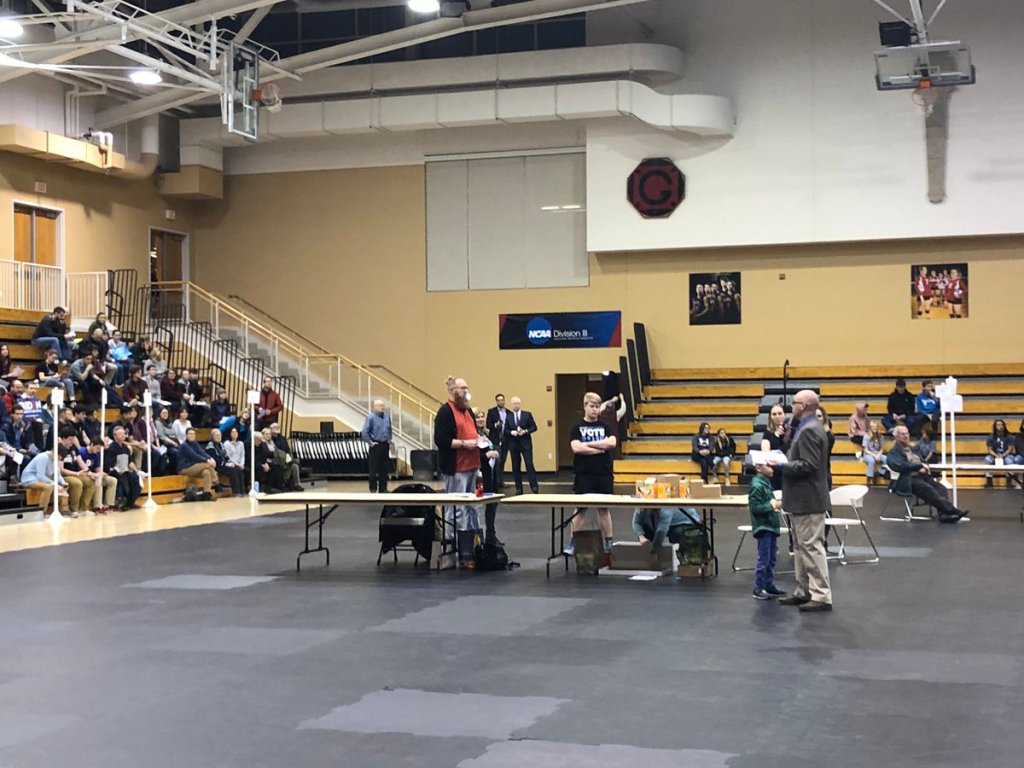
My precinct’s caucus on Monday night.

In elementary-school theatre camp, a counselor once told me that Shakespeare’s comedies were the plays that start in chaos but eventually resolve happily. His tragedies were the opposite: plays that begin pleasantly, or at least mundanely, and ended in chaos and frustration.

The first act of the caucuses was wonderful. I arrived at my precinct thirty minutes early, signed in without a hitch, was given a wristband to get in and offered stickers by a variety of candidates. My friends and I sat down on the bleachers in the section of our first choice. We watched inquisitively as our friends, neighbors, and peers began to file in and split off into their candidates’ sections of the gym. We filled out our paper ballots, stood to be counted when we were told. We watched ourselves live on CNN. To this first-time voter, Monday night felt exactly how the political process should be: well-organized, pleasant, full of useful discourse. I was thrilled to be a part of it all. Tuckered out from a long evening of fulfilling my civic duty, I went right to bed.

When I woke up the next morning, Act Two had started.

Frank Bruni for the New York Times, Feb 4
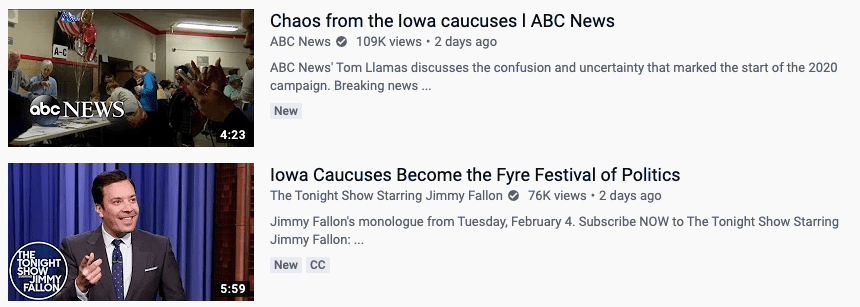
YouTube results for “Iowa Caucus”
Jeff Bercovici and Suhauna Hussain for the LA Times, Feb 4
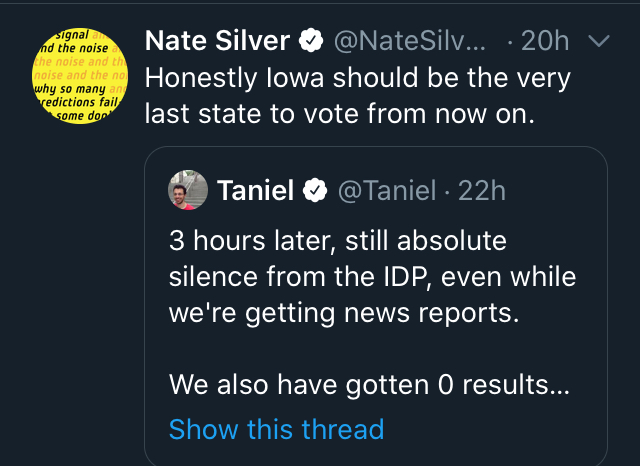
Tweet by Nate Silver, Editor-in-Chief of 538

In the last few days, the chaos has made one thing increasingly clear: the Iowa Caucuses were a tragedy of Shakespearean proportions.

At first, I was frustrated at people’s impatience. The Iowa Democratic Party, for the first time, was giving the public three times the data they normally collected and distributed. It made sense to me that this would take longer, especially considering the added processing needed for two new data points and multitudinous paper ballots. The news cycle should be a bit more patient, I thought.

Soon it became evident that something more was going on. Suspicions about the app the Iowa Democratic Party was using to report results started to spread. Shadow Incorporated, the (perhaps aptly-named) company behind the app, apologized publicly for a bug that they say caused the system to fail. Others, with more wild theories, thought maybe more than a bug was at fault, pointing to Pete Buttigieg’s campaign’s donation of over $40,000 to the app in July combined with his premature declaration of victory on Monday night. Regardless of what went down in cyberspace on Caucus night, one thing that we now know for sure is that untested, secretive software should not be used in an event as important as this.

The benefit of tragedies is that they often serve as cautionary tales. We can learn from the mistakes and chaos that we see onstage. The Iowa Caucuses should be just that for the Democratic party as other states’ primaries draw nearer: a tragedy, yes, but one we can learn from. The media and campaigns, when asking for more data, should expect more time to be taken. Maybe we shouldn’t rely solely on electronic vote reporting, instead focusing more on having strong human channels of communication.

I hope we can see the 2020 Iowa Caucuses go down in history not just as a tragedy, but as a lesson learned.

Blog Post 2: The Trolley Problem, Onstage

This week, I had the opportunity to see a dress rehearsal for an original play called Game Night. The show, written by two high schoolers, was framed as a game show for a live audience. At certain points during the show, the audience would take out their phones and vote on plot points. While this might have been stressful anyways, the authors increased the audience’s responsibility in one key way: the audience had to choose who would die, and the characters knew it. Throughout the 50-minute production, they pleaded with the audience, whom they could not see, to spare their lives. One character had a sick sister that he had to take care of, another was just about to graduate high school and go to Harvard. One had just adopted a child with his husband, and another was a single mother of two. While I was just one member of that audience, knowing that my decision would directly impact who lived and died was an intense experience. 

Going in, I told myself I’d vote in the most utilitarian way possible, make decisions that Jackson would have in this week’s article. Even though this was just a show, and the characters were just high schoolers in costume, I wanted the fewest people to be harmed. If we killed the student, it would be sad, but not as many people would be harmed as would if we killed the man who was the sole caretaker of his sister, or the single mother. Given 30 seconds to make a decision, I chose to kill both the new father and the single mother, in order to spare the student. She was the most similar to me in that situation. I felt that she deserved a chance at life. Similar emotions clouded my thinking for the rest of the performance, and all thoughts of utilitarianism went out the window. 

When I talked to other audience members after the show, it became clear that lots of them also originally opted for this approach of “do-less-harm”. (Many people also just voted randomly, because they wanted to see the most interesting ending, but the nihilist vote is something I’ll cover another time.) They didn’t always vote that way, though. One person voted against the single mother because he didn’t agree with her political views, another voted to slay the brother because he was a generally unpleasant person. In the instant that we made those decisions, we weren’t thinking about the most utilitarian choice at all. Why not?

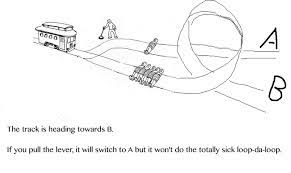
When you have time to sit and think about it, the answer to these ethical queries is clear. Don’t kill the single mother with two young kids! Switch the trolley and save five lives instead of one! Why didn’t we think of this before? We didn’t think of this before because in our discussions we’d been ignoring possibly the most important factor in how people decide things: time. We don’t have all the time in the world to make important decisions. The 30-second window will close, the trolley is going to come eventually.

Sitting in a classroom and discussing these big issues gives us that time, though, and that chance to practice these decisions, as well as to understand why other people might make different ones. An education in ethics teaches you the names of a lot of philosophers, sure, but it also gives you practice and insight. Talking about politics in school forces us to take time when we can to step back and look at the big picture. This is why classes in ethics and government are so important, and so useful.

Also, if anyone tries to get you to be an audience member for a sadistic, not-quite-legal game show? Think long and hard before you say yes. 

Blog Post 1: The “I Want” Song

For all intents and purposes, characters in musicals are supposed to be realistic. They have personality, relationships, goals. But how does a good songwriter relay this to an audience? For years, composers on Broadway have been using the same trick: the “I Want” song. An “I Want” song is a song, typically within the first fifteen minutes of a musical, that tells you exactly what the protagonist is looking for. Some well-known “I Want” numbers include “The Wizard and I” from Wicked and “Wouldn’t It Be Loverly” from My Fair Lady. Whether they want to meet the Wizard of Oz or just want a room of their own, this motivation that the protagonist sings about is the common desire that propels the show forward, unifying the audience in their new desire to see things turn out alright. 

But (though writers try their best) characters aren’t real people. Real human beings don’t blurt out their one truest desire, if they even have one, within the first fifteen minutes that you’ve met. Real human beings are complex creatures with multitudinous, layered wants and needs. You can’t truly know them after just a three-minute pop ballad. 

Understanding the American people and their politics, I think, works the same way. We’re bombarded from all sides by snappy YouTube ads, books by pundits claiming they “understand” the thoughts and motivations of entire groups of people, and articles swearing that the latest poll explains exactly how the next election will swing. Though these may help somewhat in understanding our political climate, they are what a musical character is to a human being: a nicely-boxed but overly simplified version of the real thing. We can’t learn comprehensively from just one writer or poll.

In this blog, I want to get farther into issues than that first cursory musical number, using concepts in theatre to bring political concepts to life.

Even if America had an “I Want” song, it would be hours long. 

For more about “I Want” songs in movie musicals, check out this bit from This American Life: https://www.thisamericanlife.org/259/promised-land/prologue

Design a site like this with WordPress.com
Get started